I spent Thursday and Friday trying to understand why I could send but could not receive email messages. Though my problem still existed Friday afternoon after hours of unsuccessful troubleshooting, I was reminded of customer service as it pertains to help desks.
During the time, I talked to two different help groups. At the first desk, I spoke to three people. The first person asked me several times to repeat myself as he could not hear for the ambient noise. I finally told him to tell his co-workers to quit talking. Once this was out of the way, it was clear he was not technically able to troubleshoot my problem. He connected me to a second person who was more technical and helpful but spent the time telling me the root cause was not in their server. Not once did he offer any solutions or try anything to help me. He eventually connected me to his manager who repeated the second person's line about not owning the problem. At the end, he told me a mistake was made (by the receptionist) in connecting me to them. That after one and one half hours of my time.
The second day, I called customer service and was connected to a different desk. This gentleman immediately started helping me. He had me download a program so he could see my computer screen. My first day's frustration was that I kept relaying what I was experiencing but it fell on deaf ears. They were fixated on the problem not belonging to them. This new guy immediately went to my screen and saw what I saw. He spent much time trying to help me. Though we did not fix the problem, he pointed me in a direction to follow. It was the same direction offered the previous day but I was more receptive (this time) since it came after his diligence to solve the problem. His effort and patience made me feel every possible solution had been tried.
According to the second help desk, the problem was with my mail host's server. I called their help desk for two hours and received busy signals or voice mail. Their website did not list office hours. I eventually talked to a human who confirmed there was an issue with their server. He quickly implemented a solution and by Saturday afternoon, email was working fine.
Of the processes a business possesses, those interacting with customers must be beyond reproach. Most callers to a help desk are in an ill mood when the number is dialed and it does not take much to blow a fuse. The two help desks I dealt with were diametrically opposed. And they were in the same company! One's defensive posture kept them from trying to help me. Frustration was blowing from my ears. The other talked to me in a rational and structured manner. He led me through a troubleshooting process which conveyed a helpful and empathetic message.
If anyone reading this works with customers, God bless you. Your position is critical and can make or break a supplier/customer relationship.
Showing posts with label Customers. Show all posts
Showing posts with label Customers. Show all posts
Friday, August 17, 2007


Thursday, February 01, 2007
TDCA: Train-Do-Check-Act
 I've talked at length about the PDCA cycle of continuous improvement. There is a reason why the tool has been around since the early 1900's-it works. Dr. Deming preached its power but his sermons fell on deaf, American ears. So, he flew to Japan, met a receptive audience, and the birth of Japanese continuous improvement was set in motion.
In the 2x2 table above, you see an overview of the services we provide to our clients. The combination of training and coaching (quadrant one) is our core. I call this approach TDCA: Train-Do-Check-Act.
We ask our clients to bring a problem or opportunity for improvement to class. The students (employees) are put on teams to solve the problem or improve the process. We train (T)on different tools and apply them (real time) to the project (D). We then check the results (C) and take appropriate actions (A) based on the results. Depending on the project's scope, this can be a four to eight week process.
Three benefits:
1. The employees learn new tools and how to apply the tools
2. A problem is solved or a process is improved
3. "Disciples" for continuous improvement are created. There is usually one to three employees that really embrace the process and take the "new way" to heart. They are the agents for changes that companies desperately seek to find on the shop floor.
Friday, December 01, 2006
Customer and Suppliers
 The fate of any business depends, in part, on the relationship between a supplier and its customer(s). In my experience, that relationship can take one of four forms. The four are listed above in the 2x2 table.
#1 Partnership: The customer and supplier are well run and well organized companies. Their operations are efficient and the relationship very professional. They "get things done" together. Both companies will enjoy good quality, delivery, and cost performance.
#2 Chaos: The opposite of partnership. Neither company is organized. Waste abounds in both operations. Communication is awful. People often take defensive postures when faced with difficult situations(which occur often). Money is wasted as one form of waste after another governs both companies
#3 Hypicrocy: The supplier is a well run company. Its operations are lean. A culture of continuous improvement exists. The customer is the exact opposite. Yet, the customer lays constant demands and requirements on the supplier that make no sense. The customer stays in a reactive mode and spills reaction onto the supplier. The supplier will be as accomodating as possible but will at some point ask to be compensated. The customer will balk at adding any costs. Progress will stall. Problems will not be solved.
#4 Obstinance: The converse of hypicrocy. The supplier is chaotic and out of control. Its processes and systems are not capable of providing quality products and services. The customer is world class. Well organized, the customer knows what he is doing. He will make every effort to help the supplier. Most suppliers will welcome the help. Some will resist the help thinking the customer is the problem. The supplier will spend his time justifying his actions and making everything look like the customer's fault. The customer will eventually pull the business but only after much money and man-hours are spent in trying to develop the supplier.
Where are you with your suppliers and customers? In what block do you fit? To start the road to partnership, you first need to know where the relationship stands. Be honest with yourself and each other.
Wednesday, September 06, 2006
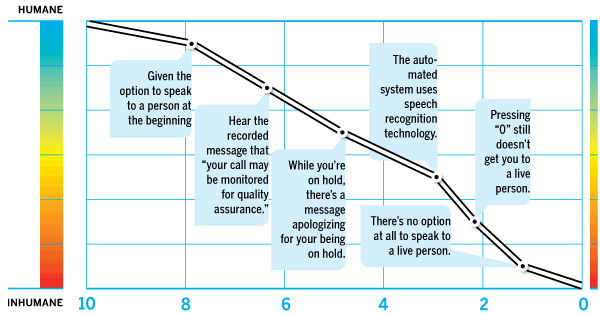
Automated Answering Services
Monday, April 17, 2006
Developing Devotees to Your Product or Service
I read this article in Fast Company, a great magazine for spurring thought
Guinness: Brew a Connection
Chris Parsons
Marketing director of beer Diageo North America Stamford, Connecticut
Years ago, when I first started drinking Guinness, I think I was a little intimidated by it. A lot of people are. It's black when other beers are yellow. It's got a creamy head when other beers have a fizzy head. When it pours, you see it surge and settle in the glass. When you first see that, you think, "That's not what I'm used to drinking." And the tendency is to sip, but it doesn't really taste as good as when you have a proper mouthful of Guinness. A brewmaster once told me, "Guinness awakens the taste buds in your mouth. It's alive."
Those qualities of the beer -- distinct, proud, individualistic -- are the same qualities that our drinkers associate with themselves. It comes right through the heart of the product and creates an emotional connection. We try to strengthen that by being as close as we can to the consumer. A couple of years ago, we were holding an event for our most ardent Guinness fans, something we do four times a year, two or three weeks at a time. We discovered that many of them thought Guinness would make them fat. Guinness has only 125 calories, about 15 more than Bud Light. But we realized we had never communicated that. Now we're running an ad campaign saying, "Guinness only has 125 calories, but not on purpose." We didn't change the product, we just listened. Customers loved this, and our volume has since gone through the roof.
We don't lose customers. Once or twice you hear about someone who had a bad experience. They'll write a letter, but then at the end they'll write, "I'll still drink it, I just wanted to tell you." You never hear, "I used to be a Guinness drinker."
Chris Parsons recently added a refrigerated Guinness keg system to his deck.
Netflix: Project a New Experience
Leslie Kilgore
Chief marketing officer Netflix Inc. Los Gatos, California
What people want in a movie is an escape into this different world without everyday hassles. With Netflix, I don't have to go to the video store, I can keep movies as long as I want, and I get them at home with a prepaid return envelope. If you go into a large traditional store, they're only going to have 4,000 titles. We have 20,000 titles that span 250 genres. Customer service, convenience, and selection are the essence of our brand.
More than 90% of our customers tell us they evangelize the service to friends and family. The biggest impact we've seen is people spending a lot of time talking about what's in their queue of movies they want shipped to them next. Some even use Netflix as a verb, as in, "Whale Rider? I Netflixed it."
Customers have that level of enthusiasm because we have a great experience, and that's why constantly improving the quality of the service is an obsessive part of our culture. A few years ago, we had one distribution center located here in the San Francisco Bay area, and folks in the area absolutely loved receiving their movies in one day. We had a very healthy subscriber base on the East Coast, but we knew those customers would be happier if they got their movies as quickly as customers in San Francisco. So we've opened up 24 distribution centers all around the country, and now more than 80% of our subscribers can receive their movies in about a day. To know that ultimately Netflix makes people's weekends better is incredibly rewarding.
Episodes of Six Feet Under, Sex and the City, and The Sopranos are currently on rotation in Leslie Kilgore's DVD player.
ESPN: Fan the Relationship's Flames
Lee Ann Daly
Executive vice president, marketing ESPN Inc.New York, New York
We take sports very seriously, but we don't take ourselves very seriously. That goes back to ESPN's roots. Our founders were bohemian sports fans in the same way that poets and painters and jazz musicians believe in what they're doing in a passionate way. They really just wanted to create a 24-hour sports, news, and information network to share with other fans.
Although ESPN has grown into 40 different businesses [25 television networks globally, a radio network, a magazine, ownership of the professional bass-fishing and extreme-sports tourneys, a chain of sports bar/restaurants, etc.], what hasn't changed is our conversation with fans. It's almost like a club. So all of these extensions of the original ESPN must serve our relationship with each fan. When we expand, the most important thing to me is whether we can transform the business that we go into by better serving the fan. If it doesn't, you'll make money for 10 minutes, and then the fan will be disappointed and you won't be making any more money.
I think it's very difficult to put up with us if you don't love sports. What I'm talking about is a fundamental respect and understanding for just how important sports are in people's lives. Even though many people don't consider themselves to be sports fans, when you delve a little beneath the surface, most people are. To some degree, I don't think you can call yourself an American if you're not a sports fan.
Lee Ann Daly grew up in a house with three football-playing brothers where there was "a lot of yelling at the television."
Luna Bar: Start a Movement
Yana Kushner
Director of Luna equity and advanced product development Clif Bar Inc.Berkeley, California
What's unique about Luna nutrition bars -- and what inspires me -- is that the brand honors and supports women. There's a whole world of products that stereotype us and tell us what's wrong with us. Luna is there to lift us up.
In the beginning, a lot of our business was built by word of mouth -- women telling each other about Luna bars, sharing them with their sisters, mothers, girlfriends. My favorite Luna story is from a woman working in an ad agency, in a fast-paced, stressful environment. Her boss, also a woman, would pull the younger, female, more-junior workers into her office during times of stress, sit them down, open up her bottom drawer, pull out some Luna bars, take a deep breath, and have what she called a "Luna moment."
Why do people feel this way? I think the first layer of loyalty is they love how the bar tastes, the nutrients in it, that it's all natural. But beyond that, they quickly move up and join the Luna movement: social purpose, balance, healthy living, wanting it all. These are very much the values we stand for, and because we have that in common with them, they feel like they've found a friend.
A couple of years ago, we started something on the back of the bar called "Luna Dedication," where the women of Luna wrote personal dedications to women who have touched their lives in some way. By giving them a piece of ourselves, they feel part of the Luna family. It's a two-way street. It keeps them excited and passionate, and it also keeps us internally passionate.
Yana Kushner was particularly moved by the woman who requested Luna wrappers in bulk so she could sew Luna purses for all of her girlfriends.
Harley-Davidson: Ride Your Heritage
Joanne Bischmann
Vice president, marketingHarley-Davidson Inc.Milwaukee, Wisconsin
I am still awed by the lengths our customers will go to show their commitment. Recently, I saw a man who had tattooed a portrait of our four founding fathers and our 100th anniversary logo on his back. When Harley hired me 14 years ago, they told me, "This will be the best job you're ever going to have because it isn't just about working at a company that makes motorcycles. The founding fathers actually seep out of the walls here." Back then I thought they were totally nuts. Now I know that that sense of freedom, individuality, independence, and irreverence has always been part of Harley.
We have a lot of people call us who want the manual on how to keep customers passionate. There's no manual. And there are so many ways to screw this up. In the '90s, we couldn't satisfy demand, so people had to wait up to two years for a bike. When we would place ads, I'd personally get letters saying, "Tell me where this product is. I've been looking at 10 dealers, and they don't have it." That was really frustrating. We tried to bottle demand and show customers other opportunities to experience Harley -- through the clothing, through events we hold. Don't give up the dream. Just give us a little time. Everyone's thinking we've got the best job because the product was basically sold out, but what marketing really had to do was keep relationships going.
We never forget that this is a brand that none of us can individually own. We are a tribe that carries on its traditions so it's here for future generations.
It took Joanne Bischmann only 10 months after starting work at Harley to "get the itch" and apply for her motorcycle license.
Copyright © 2006 Mansueto Ventures LLC. All rights reserved.Fast Company, 375 Lexington Avenue.,New York , NY 10017
Guinness: Brew a Connection
Chris Parsons
Marketing director of beer Diageo North America Stamford, Connecticut
Years ago, when I first started drinking Guinness, I think I was a little intimidated by it. A lot of people are. It's black when other beers are yellow. It's got a creamy head when other beers have a fizzy head. When it pours, you see it surge and settle in the glass. When you first see that, you think, "That's not what I'm used to drinking." And the tendency is to sip, but it doesn't really taste as good as when you have a proper mouthful of Guinness. A brewmaster once told me, "Guinness awakens the taste buds in your mouth. It's alive."
Those qualities of the beer -- distinct, proud, individualistic -- are the same qualities that our drinkers associate with themselves. It comes right through the heart of the product and creates an emotional connection. We try to strengthen that by being as close as we can to the consumer. A couple of years ago, we were holding an event for our most ardent Guinness fans, something we do four times a year, two or three weeks at a time. We discovered that many of them thought Guinness would make them fat. Guinness has only 125 calories, about 15 more than Bud Light. But we realized we had never communicated that. Now we're running an ad campaign saying, "Guinness only has 125 calories, but not on purpose." We didn't change the product, we just listened. Customers loved this, and our volume has since gone through the roof.
We don't lose customers. Once or twice you hear about someone who had a bad experience. They'll write a letter, but then at the end they'll write, "I'll still drink it, I just wanted to tell you." You never hear, "I used to be a Guinness drinker."
Chris Parsons recently added a refrigerated Guinness keg system to his deck.
Netflix: Project a New Experience
Leslie Kilgore
Chief marketing officer Netflix Inc. Los Gatos, California
What people want in a movie is an escape into this different world without everyday hassles. With Netflix, I don't have to go to the video store, I can keep movies as long as I want, and I get them at home with a prepaid return envelope. If you go into a large traditional store, they're only going to have 4,000 titles. We have 20,000 titles that span 250 genres. Customer service, convenience, and selection are the essence of our brand.
More than 90% of our customers tell us they evangelize the service to friends and family. The biggest impact we've seen is people spending a lot of time talking about what's in their queue of movies they want shipped to them next. Some even use Netflix as a verb, as in, "Whale Rider? I Netflixed it."
Customers have that level of enthusiasm because we have a great experience, and that's why constantly improving the quality of the service is an obsessive part of our culture. A few years ago, we had one distribution center located here in the San Francisco Bay area, and folks in the area absolutely loved receiving their movies in one day. We had a very healthy subscriber base on the East Coast, but we knew those customers would be happier if they got their movies as quickly as customers in San Francisco. So we've opened up 24 distribution centers all around the country, and now more than 80% of our subscribers can receive their movies in about a day. To know that ultimately Netflix makes people's weekends better is incredibly rewarding.
Episodes of Six Feet Under, Sex and the City, and The Sopranos are currently on rotation in Leslie Kilgore's DVD player.
ESPN: Fan the Relationship's Flames
Lee Ann Daly
Executive vice president, marketing ESPN Inc.New York, New York
We take sports very seriously, but we don't take ourselves very seriously. That goes back to ESPN's roots. Our founders were bohemian sports fans in the same way that poets and painters and jazz musicians believe in what they're doing in a passionate way. They really just wanted to create a 24-hour sports, news, and information network to share with other fans.
Although ESPN has grown into 40 different businesses [25 television networks globally, a radio network, a magazine, ownership of the professional bass-fishing and extreme-sports tourneys, a chain of sports bar/restaurants, etc.], what hasn't changed is our conversation with fans. It's almost like a club. So all of these extensions of the original ESPN must serve our relationship with each fan. When we expand, the most important thing to me is whether we can transform the business that we go into by better serving the fan. If it doesn't, you'll make money for 10 minutes, and then the fan will be disappointed and you won't be making any more money.
I think it's very difficult to put up with us if you don't love sports. What I'm talking about is a fundamental respect and understanding for just how important sports are in people's lives. Even though many people don't consider themselves to be sports fans, when you delve a little beneath the surface, most people are. To some degree, I don't think you can call yourself an American if you're not a sports fan.
Lee Ann Daly grew up in a house with three football-playing brothers where there was "a lot of yelling at the television."
Luna Bar: Start a Movement
Yana Kushner
Director of Luna equity and advanced product development Clif Bar Inc.Berkeley, California
What's unique about Luna nutrition bars -- and what inspires me -- is that the brand honors and supports women. There's a whole world of products that stereotype us and tell us what's wrong with us. Luna is there to lift us up.
In the beginning, a lot of our business was built by word of mouth -- women telling each other about Luna bars, sharing them with their sisters, mothers, girlfriends. My favorite Luna story is from a woman working in an ad agency, in a fast-paced, stressful environment. Her boss, also a woman, would pull the younger, female, more-junior workers into her office during times of stress, sit them down, open up her bottom drawer, pull out some Luna bars, take a deep breath, and have what she called a "Luna moment."
Why do people feel this way? I think the first layer of loyalty is they love how the bar tastes, the nutrients in it, that it's all natural. But beyond that, they quickly move up and join the Luna movement: social purpose, balance, healthy living, wanting it all. These are very much the values we stand for, and because we have that in common with them, they feel like they've found a friend.
A couple of years ago, we started something on the back of the bar called "Luna Dedication," where the women of Luna wrote personal dedications to women who have touched their lives in some way. By giving them a piece of ourselves, they feel part of the Luna family. It's a two-way street. It keeps them excited and passionate, and it also keeps us internally passionate.
Yana Kushner was particularly moved by the woman who requested Luna wrappers in bulk so she could sew Luna purses for all of her girlfriends.
Harley-Davidson: Ride Your Heritage
Joanne Bischmann
Vice president, marketingHarley-Davidson Inc.Milwaukee, Wisconsin
I am still awed by the lengths our customers will go to show their commitment. Recently, I saw a man who had tattooed a portrait of our four founding fathers and our 100th anniversary logo on his back. When Harley hired me 14 years ago, they told me, "This will be the best job you're ever going to have because it isn't just about working at a company that makes motorcycles. The founding fathers actually seep out of the walls here." Back then I thought they were totally nuts. Now I know that that sense of freedom, individuality, independence, and irreverence has always been part of Harley.
We have a lot of people call us who want the manual on how to keep customers passionate. There's no manual. And there are so many ways to screw this up. In the '90s, we couldn't satisfy demand, so people had to wait up to two years for a bike. When we would place ads, I'd personally get letters saying, "Tell me where this product is. I've been looking at 10 dealers, and they don't have it." That was really frustrating. We tried to bottle demand and show customers other opportunities to experience Harley -- through the clothing, through events we hold. Don't give up the dream. Just give us a little time. Everyone's thinking we've got the best job because the product was basically sold out, but what marketing really had to do was keep relationships going.
We never forget that this is a brand that none of us can individually own. We are a tribe that carries on its traditions so it's here for future generations.
It took Joanne Bischmann only 10 months after starting work at Harley to "get the itch" and apply for her motorcycle license.
Copyright © 2006 Mansueto Ventures LLC. All rights reserved.Fast Company, 375 Lexington Avenue.,New York , NY 10017
Saturday, January 21, 2006
Customers and Suppliers
In today's paper, there were two articles that illustrated the relationship between customers and suppliers.
The title of the first article: Ohio Nuclear Plant Owner to pay $28M.
If your business ships a product, how many times have you suspected that defective product was in routeto your customer? Do you inform them or keep silent and hope that nothing happens? There is nothing worse than staying mum and receiving the call days later. Yes, the customer did receive bad product and now you have a mess on your hands. It's analogous to when your children do something bad and try to lie their way out of trouble. The truth will set them free but the dishonesty becomes the big issue.
The owner of the nuclear plant tried to cover up an acid leak in his plant. In the worst case scenario, the acid could have eaten throught the reactor vessel's six inch steel cap. I'm not sure what that means but it doesn't sound good.
So the customer is the community. The owner and his employees had a responsibility to inform civic leaders of this issue. We don't know what would have happened (we never know when we call the customer) but let's hope that the community and company would work together in a spirit of partnership to mitigate the risk.
The other article's title: Japan Stops Shipments of U.S. Beef. Think of this process flow:
1. U.S. raises cattle
2. U.S. slaughters cattle
3. U.S. inspects beef
4. U.S. ships beef to customers
5. Customers inspect beef
6. If beef is good, distribution to the public occurs. If bad, the beef is quarantined and shipments are halted.
Does this sound familiar? Of course it does. It doesn't matter is you ship toys, engines, or beef, there is always the fundamentals of the customer-supplier relationship. You (as the supplier) better have the quality system to support the relationship.
According to the article, Japan accounts for 35.9% of the U.S.' global sales of beef. We'll call them an important customer. On Friday, Japan halted all shipments of U.S. beef because of mad cow fears. This came six weeks after Japan lifted a two-year ban on American beef.
The recent incident resulted from a Japanese inspection of a veal shipment from a plant in New York. The U.S Agriculture Secretary's response included immediate dispatch of inspectors to Japan and unannounced inspections at U.S plants.
Though the complexity of this issue is mind-boggling, the core issue is fundamental; the action orginally taken to eliminate mad cow disease in the U.S (allowing Japan to lift the two year ban) did not hold. In short, their corrective action did not work. Now the U.S is back in containment mode.
As quality professionals, try to look at societal issues with your unique perspective.
Thursday, December 29, 2005
Customer Service

I mentioned in a recent post that it is often helpful to use analogies to help explain and understand business practices. A technical term for this is benchmarking. I ran across a great example of customer service this morning. The following letter was placed inside my morning paper by the delivery person.
"Dear Friends,
Thank you so much for your kindness during this Christmas season. I am overwhelmed by your tips and kind words every year at this time. I must have finally learned to miss the flowers. Seriously, I know some of you wonder why I throw the papers like I do. Please understand that since I took this job three years ago, till this day our bosses instruct us to throw the papers on the grass and not on cement because it will get wet on the cement much quicker than the grass. It took me a while to figure it out but the closer I can get to the house, the less complaints I got. If anyone has a problem with the placement of the paper, please feel free to drop me a line or give me a call and leave a message (he gave us his address and phone number). I will be more than glad to throw it to a more suitable area. These days with high gas prices, it is customers like you that make this job worthwhile."
Subscribe to:
Posts (Atom)



 Posts
Posts